How to Overcome Test Anxiety: An Evidence-Based Plan That Actually Works
You studied for weeks. You knew the material cold the night before. Then you sat down, the clock started, and your mind went blank. Your heart raced, your palms went damp, and the first question looked like it was written in another language. By the time your brain came back online, you'd already lost fifteen minutes and most of your confidence.
If that sounds familiar, you're dealing with test anxiety, and you're far from alone. Surveys estimate that somewhere between 25 and 40 percent of students experience it at a level that hurts performance. The frustrating part is that it has almost nothing to do with how much you know. Test anxiety is a problem of access, not knowledge. The information is in your head. Anxiety just slams the door on your way to retrieve it.
The good news: this is one of the most studied problems in educational psychology, and the fixes are concrete. Below is a plan built from that research, organized by when you use each piece, before the exam, in the minutes leading up to it, and during the test itself.
Why anxiety hijacks a brain that's perfectly prepared
To fix the problem, it helps to understand the mechanism. When you feel threatened, your body triggers a stress response: adrenaline spikes, breathing speeds up, and blood flow shifts toward your muscles. This system evolved to help you sprint away from danger, not to recall the dates of the French Revolution.
The cognitive cost shows up in a specific place: your working memory. Working memory is the mental scratchpad you use to hold a question, pull up related facts, and assemble an answer. It's small and easily crowded. Psychologists Sian Beilock and Thomas Carr demonstrated that anxious thoughts, the running commentary of "I'm going to fail," "everyone else is finishing," "why can't I remember this," occupy that scratchpad directly. The worry literally competes for the same mental space you need to solve the problem.
This is why test anxiety produces that maddening experience of blanking on material you genuinely know. The knowledge is stored in long-term memory, intact. But to use it, you have to load it into working memory, and the worry got there first.
Two implications follow. First, anything that quiets the worry frees up capacity. Second, the physical symptoms and the mental symptoms feed each other, so you can attack the problem from either side. You don't have to win the argument with your anxious thoughts. You can also just calm your body, and the thoughts often follow.
In the weeks before: build a foundation anxiety can't easily shake
Most anti-anxiety advice focuses on exam day. That's a mistake. The strongest protection is built in the weeks beforehand, because the deepest root of test anxiety is the quiet suspicion that you aren't actually prepared.
Study the way you'll be tested
The single most underrated anxiety tool is practice testing. When you rehearse retrieval under conditions that resemble the real exam, two things happen. Your memory for the material gets stronger, and the testing situation itself stops feeling novel and threatening.
Do timed practice questions. Sit at a desk, not on your bed. Put your phone in another room. Use past papers or generate practice questions and answer them under a clock, without notes. The first few times will feel uncomfortable, and that discomfort is the point. You're teaching your nervous system that this situation is survivable. By exam day, the format is old news, and your brain reserves its alarm for genuine emergencies.
Avoid the false comfort of passive review
Rereading notes and highlighting feel productive and calming, which is exactly why they're dangerous. They build familiarity with the material without building the ability to retrieve it. That gap, knowing it when you see it but not being able to produce it on demand, is where test anxiety lives. The night before, passive review tells you that you're ready. The exam reveals you weren't, and the shock fuels panic.
Sleep is not optional
Sleep deprivation amplifies emotional reactivity. A tired brain is more likely to interpret a hard question as a catastrophe. It also weakens the memory consolidation that happened during your study sessions. Pulling an all-nighter before an exam is close to the worst thing an anxious student can do: it degrades both the knowledge and the emotional regulation you need. Protect your sleep in the final week, and especially the final night.
The night before and the morning of: managing the build-up
Anticipatory anxiety, the dread that builds in the hours before, can be as draining as the exam itself. A few specific moves help.
Make a plan, then stop studying
Decide in advance what you'll do in the morning: what time you'll wake, what you'll eat, when you'll leave, what you'll bring. Uncertainty feeds anxiety, and a simple plan removes a dozen small decisions from a moment when your mental resources are already strained. Once your plan is set and you've done a light review, stop. Cramming new material at this stage rarely adds knowledge, but it reliably adds panic.
Eat and hydrate
Low blood sugar and dehydration both mimic and worsen anxiety symptoms: shakiness, racing heart, difficulty concentrating. Eat a normal meal with some protein and slow-digesting carbohydrates. Don't experiment with a giant coffee you wouldn't normally drink, since caffeine raises heart rate and can tip nervousness into full activation.
Try expressive writing
This one sounds too simple to work, but it has solid evidence behind it. In a study published in the journal Science, Ramirez and Beilock had students spend about ten minutes before a high-pressure exam writing freely about their worries and feelings about the test. The students who did this expressive writing significantly outperformed those who sat quietly, and the effect was strongest for the most anxious students.
The theory is that putting your worries on paper offloads them from working memory. Instead of the anxious thoughts circling in the background, draining capacity, you externalize them and free up mental space for the exam. Try it: for ten minutes the morning of, write honestly about how you feel and what you're afraid of. You're not trying to solve anything. You're just emptying the scratchpad.
In the room: techniques for the moment of panic
Even with good preparation, the body sometimes fires off its alarm. Here's how to handle it without losing the exam.
Breathe out longer than you breathe in
Of all the in-the-moment techniques, controlled breathing has the most direct physiological effect. When you extend your exhale, you activate the parasympathetic nervous system, the branch that calms you down, and you slow your heart rate within seconds.
A simple pattern: breathe in through your nose for a count of four, then out slowly for a count of six or eight. Do this for four or five cycles. The longer exhale is the active ingredient. This isn't a vague relaxation suggestion; it's a mechanical lever on your nervous system that works whether or not you believe in it. Practice it a few times during your study sessions so it's automatic when you need it.
Reframe the jitters as fuel
Here's a counterintuitive finding that can change everything. The physical signs of anxiety, the pounding heart, the rush of energy, are nearly identical to the signs of excitement. The difference is largely in how you label them.
Research by Alison Wood Brooks found that people who reappraised their nerves by telling themselves "I am excited" performed better than those who tried to calm down. Telling yourself to relax fights the body's activation and usually fails. Reframing the same arousal as readiness, "my body is gearing up to perform," channels it. The next time your heart races before a test, try silently saying, "I'm fired up for this," rather than "I need to calm down." You're not lying to yourself. You're choosing the more useful interpretation of a real bodily state.
Start with a question you can answer
You don't have to take the exam in order. Scan the paper and answer an easy question first. A quick win does two things: it puts points on the board, and it gives your brain evidence that you do know this material, which interrupts the panic spiral. Save the hard questions for after you've warmed up and your working memory has settled.
If you blank, don't stare
Freezing on a question and staring harder only deepens the panic. Mark it, move on, and come back. Often the answer surfaces on its own once the pressure of that specific question is off. Forcing retrieval under acute stress is like trying to remember a name by gripping your forehead, it works better when you stop straining.
Narrow your focus to the next single action
When everything feels overwhelming, shrink the task. You don't have to pass the whole exam right now. You only have to read the next question. Then answer it. Then read the one after. Anxiety thrives on the imagined enormity of the whole; it loses power when you reduce the world to the one concrete thing in front of you.
Rewiring the story you tell yourself
Beneath the physical symptoms, test anxiety is usually held together by a set of beliefs, and these are worth examining over the longer term.
Challenge catastrophic thinking
Anxious students tend to inflate the stakes. One exam becomes a referendum on their intelligence, their future, their entire worth. When you catch a thought like "if I fail this, my life is over," ask whether it's literally true. Almost always it isn't. There are retakes, alternative paths, and the simple reality that one test rarely determines as much as it feels like in the moment. This isn't empty positivity. It's accuracy. Catastrophic thoughts are distortions, and naming them as distortions drains some of their power.
Separate your performance from your worth
A lot of test anxiety comes from fusing the two: a bad grade doesn't just mean you got questions wrong, it means you are a failure. Untangling these is freeing. Your score measures how you did on a specific set of questions on a specific day. It is not a measurement of you. Students who hold this view consistently report less crippling anxiety, because the threat shrinks back to its real size.
Watch the comparison trap
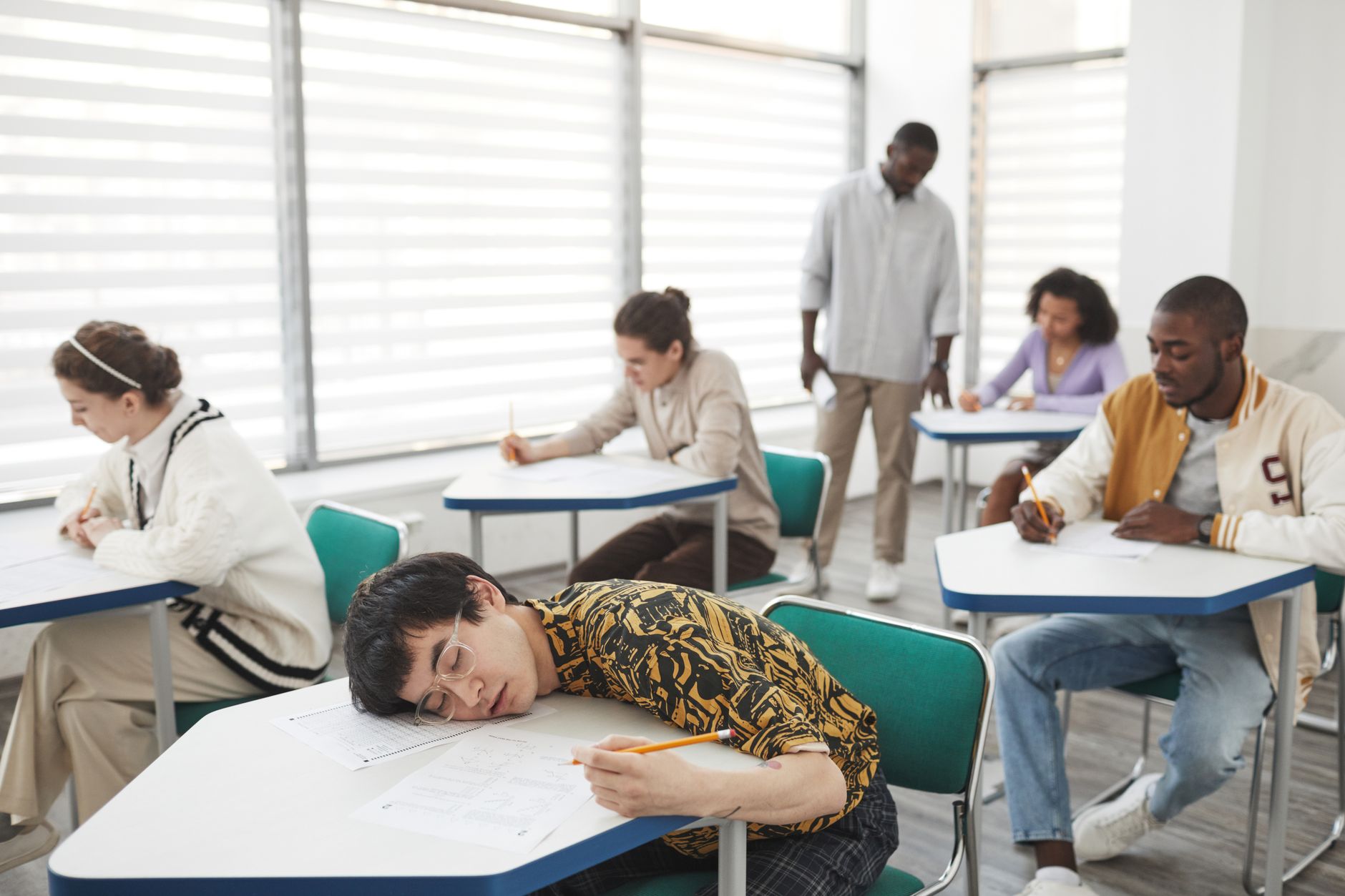
The person scribbling furiously beside you isn't your competition, and they aren't proof that you're behind. Maybe they're guessing. Maybe they'll finish early and fail. Their pace tells you nothing about your performance, and monitoring it just burns the working memory you need for your own paper. Keep your eyes on your own exam.
When to get extra support
For most people, the strategies above make a real difference. But if test anxiety is severe, if it causes panic attacks, nausea, or weeks of dread, or if it's part of a broader pattern of anxiety, it's worth talking to a counselor or doctor. Cognitive behavioral therapy is well established for anxiety and works especially well for the test-specific kind. Many schools and universities offer it free through their counseling centers. Asking for help here is no different from asking for help with any other skill. It's not a sign that you're broken.
Putting it together
Test anxiety feels like a wall between what you know and what you can show. But it's a wall made of specific, addressable parts: a stress response you can calm through your breath, a worry that you can offload onto paper, a story you can rewrite, and a preparation gap you can close with real practice instead of comfortable rereading.
You won't eliminate nerves entirely, and you shouldn't try to. A little arousal sharpens focus. The goal isn't a flat, calm mind; it's a body that's activated and a working memory that's clear, so that the knowledge you spent weeks building can finally make it onto the page. Start with the preparation, because confidence built on genuine readiness is the foundation everything else stands on. Then, on the day, breathe out slowly, reframe the buzz as readiness, answer the easy one first, and take the exam one question at a time.
Ready to Create Better Exams?
Join thousands of educators using QuickExam AI to save time and create engaging assessments.