AP Exam Prep: A Strategic Last-Week Study Plan That Beats Marathon Cramming

If your AP exam is seven days away and you are looking at a stack of review books wondering where to start, this is for you. The last week before an AP test is when most students panic-cram, and most of that effort is wasted. The problem is not effort — it is direction. A strategic seven-day plan that prioritizes retrieval, full-length practice, and targeted weakness work will beat a 14-hour marathon study session almost every time.
This is a practical, day-by-day plan built on what cognitive science actually says about cramming, recall, and exam performance. It also accounts for the format of AP exams specifically: the multiple-choice section, the free-response section, and the time pressure that catches students off guard even when they know the material.
Why the last week is different
By the time you are seven days out, you are not learning new content anymore. You should not be reading new chapters. You should not be making fresh flashcards from scratch. The last week is about three things: surfacing what you already know, finding the holes, and getting your nervous system used to the test format.
A common mistake is treating the last week like the first week of a study schedule. Students re-read textbooks, highlight new colors over old highlights, and rewatch review videos at 1.5x speed. That feels productive because it generates a lot of input. But input is not the bottleneck this close to the exam. Output is. You need to be pulling information out of your head under conditions that resemble the test, not pouring more in.
There is solid evidence on this. A 2013 meta-analysis by Dunlosky and colleagues at Kent State ranked study techniques by their effect on actual test performance. Re-reading and highlighting — the two most popular strategies among students — rated as "low utility." Practice testing and distributed practice rated "high utility." If you only have a week, you cannot space your studying across months, but you can still pivot away from re-reading and toward retrieval.
Day 7 and 6: Audit, do not review
Spend the first two days of your week diagnosing rather than studying. This sounds counterintuitive, but it is the most valuable move you can make all week.
Pull up the official College Board course and exam description for your subject. The CED is free and lists every unit, topic, and learning objective the test covers. Read through it and rate yourself on each topic on a simple three-point scale: solid, shaky, blank.
Do not consult your notes while you do this. If you cannot remember what "stoichiometry" means without checking, mark it blank. The whole point is to find what you do not know, not what you can recognize when prompted.
After the audit, you should have a list of maybe 15 to 30 topics rated shaky or blank. That is your study target. Everything rated solid gets a quick recall pass and then leaves your priority list. You will be tempted to re-study things you already know because they feel comfortable. Resist this. Comfort is not learning.
Spend the rest of these two days doing rapid recall on your shaky topics. The blurting method works well here: read a topic name, write down everything you remember on a blank page for two or three minutes, then check what you missed. Do not write neat notes. The goal is to force retrieval, not produce study materials.
Day 5 and 4: Full-length practice tests
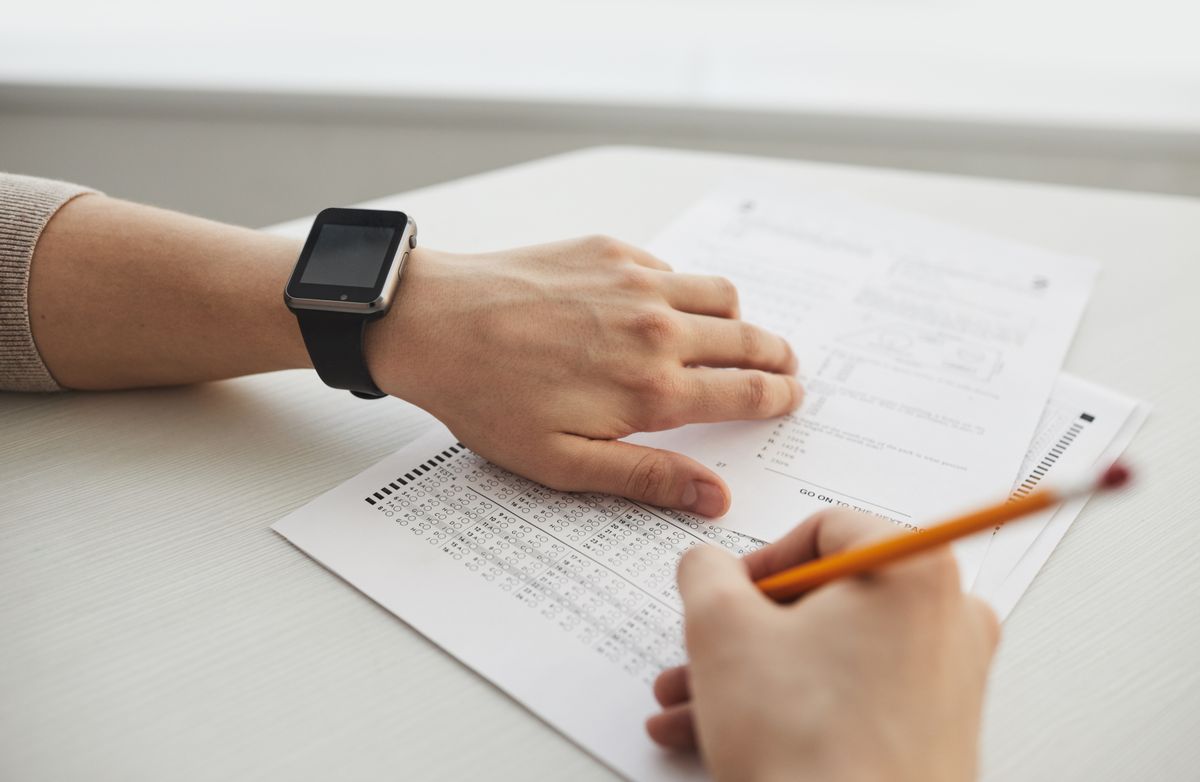
Now you need a full-length, timed practice test. The College Board releases past exams for most AP subjects — these are your gold standard. If your subject has a publicly available past exam, use it. If not, the practice tests in Princeton Review, Barron's, or Kaplan books are acceptable substitutes.
Take the test under real conditions. That means:
- Same time of day as your actual exam (most AP tests start at 8 a.m. or 12 noon).
- A printed copy if possible, or a quiet room with your laptop and no other tabs open.
- Strict timing. If you have 60 minutes for 45 multiple-choice questions, set a timer and stop when it goes off.
- No notes, no breaks beyond what the real exam allows, no phone.
Most students do not do this. They take "practice tests" with their notes open, pause when they feel tired, and skip questions they find hard. That is studying, not testing, and it does not predict your real performance.
After you finish, score yourself. Then spend the next day going through every question you got wrong or guessed on. For each one, write down — in one sentence — what specifically you did not know. Was it a content gap? A misread question? A calculation error? A timing issue?
This error log is more valuable than any review book. It is a personalized list of exactly what to fix in your remaining days.
Day 3 and 2: Targeted weakness work plus free-response drills
By now you know your weak topics from the audit and your error patterns from the practice test. Spend day 3 hitting those topics directly. Use practice questions, not re-reading. If you got stoichiometry questions wrong, do 20 more stoichiometry questions. If you flubbed DBQ thesis statements, write three more thesis statements.
The other half of these two days goes to free-response practice. AP free-response sections are where many students lose the most points relative to their preparation. The questions are not just content checks — they reward a specific structure that you have to practice producing under time pressure.
For document-based and long essay questions on AP history exams, write at least two timed essays. Do not just outline them. Write them, full sentences, with a stopwatch running. Then compare your essay to the published rubric and a sample high-scoring response. The College Board publishes both for past exams.
For STEM free-response questions, work through the answer with full setup and units, even when the answer feels obvious. Most points on AP science exams come from showing your work — equations, substitutions, units — not from getting the final number right. A correct number with no setup often scores zero.
For AP Language and Literature, write at least one full timed essay per prompt type. Reading sample student responses scored 6 and above will teach you more about what graders want than any review book chapter.
Day 1: Light recall, logistics, and sleep
Twenty-four hours out, your studying should be light. The marginal benefit of a 12-hour cram session the day before is approximately zero, and the marginal cost — sleep deprivation — is severe.
Sleep affects memory consolidation in a measurable way. Studies on declarative memory show that students who sleep seven to nine hours the night before a test outperform sleep-deprived peers on tasks that require recall of recently learned information. The effect is roughly equivalent to an extra letter grade on a normal-curve exam. Sleeping is not a break from studying. It is part of studying.
Spend day 1 doing a final pass on your error log and shaky-topic list. Use flashcards or quick recall, not deep reading. Stop studying by mid-afternoon at the latest.
Then handle logistics. Pack your bag the night before:
- Two black or dark blue ink pens.
- Two number 2 pencils for the multiple-choice scantron.
- A College Board-approved calculator if your subject allows one (check the policy — bringing the wrong calculator gets it confiscated).
- A government or school-issued photo ID.
- A watch without internet or alarm features, if your testing center allows it.
- Water and a snack for the break.
Confirm your test location and start time. AP exams typically begin at 8 a.m. local time, and you need to be in your seat 15 to 30 minutes before that. Plan for traffic and parking.
Eat a normal dinner. Go to bed early enough to get at least seven hours of sleep. Do not take sleep aids you have not used before — the morning grogginess can cost you points.
The morning of the exam
Eat a real breakfast that includes protein and complex carbohydrates. Skip the energy drink experiment if you have not been training your caffeine tolerance for it. A cup of coffee is fine if you normally drink coffee. A pre-workout shake when you have never taken one is a bad idea.
Arrive early. Use the time to walk around, stretch, and do five minutes of slow breathing. Do not try to cram in the parking lot. Looking at notes in the final 30 minutes raises anxiety and almost never adds points.
When the exam starts, pace yourself by sections. For multiple choice, calculate roughly how many minutes you have per question and check the clock at the quarter, half, and three-quarter points. If you fall behind, mark uncertain questions and move on. Coming back to one hard question after answering 20 easy ones often reveals the answer because your brain has been working on it in the background.
For free response, read all the questions before you start writing. Choose the one you can answer most fully and start there. Confidence on the first essay translates to better writing on the rest.
Subject-specific notes
A few subject-specific points worth knowing:
AP US History, World History, and European History: The DBQ is worth 25 percent of your score. Writing a strong thesis and contextualization paragraph is non-negotiable. Practice these two paragraphs in isolation if you are short on time.
AP Calculus AB and BC: The free-response section is half your grade and rewards units, labels, and full setup. Write "f(x) =" before every function. Write "by the chain rule" before every chain rule application. Graders are looking for explicit reasoning, not just correct numbers.
AP Biology and Chemistry: Memorizing every equation is less useful than knowing which equation applies to which question type. Practice categorizing problems before you solve them.
AP English Language and Literature: The rhetorical analysis and synthesis essays reward specific evidence over general claims. Quote and cite specific lines or sources, even briefly.
AP Physics 1 and 2: Free-response questions often test conceptual reasoning, not just calculation. Practice writing clear two- to three-sentence explanations of why something happens, not just what it equals.
AP Computer Science A: The free-response questions are graded on whether your code would actually run. Trace your code by hand on a piece of scratch paper before submitting.
What not to do
A short list of last-week mistakes worth avoiding:
- Do not buy a new review book. You do not have time to absorb it.
- Do not study with a study group on the day before the exam unless that group has historically helped your performance. Group study is high variance and often turns into venting.
- Do not pull an all-nighter. The data is unambiguous: sleep loss costs more points than the extra studying gains.
- Do not watch reaction videos or read horror stories about the test online. These raise anxiety and add nothing.
- Do not check your answers against unofficial answer keys after the exam. You are taking another AP test next week or the week after, and stewing on uncertain answers will eat into your prep for that one.
The mindset that actually helps
The students who walk out of AP exams feeling good are usually not the ones who studied the most hours. They are the ones who diagnosed their gaps early, practiced under realistic conditions, and trusted their preparation enough to sleep the night before.
A strategic last week is mostly subtractive. You are stripping away the topics you already know, the techniques that do not work, and the panic that pretends to be productivity. What is left — targeted recall, full-length practice, and rest — is what actually moves your score.
You do not need 60 hours this week. You need 25 to 35 focused hours, distributed across audit, practice testing, weakness work, and recovery. Do that, and you will walk into the exam knowing exactly what is on the test and exactly what you can do about it.
Good luck.
Ready to Create Better Exams?
Join thousands of educators using QuickExam AI to save time and create engaging assessments.