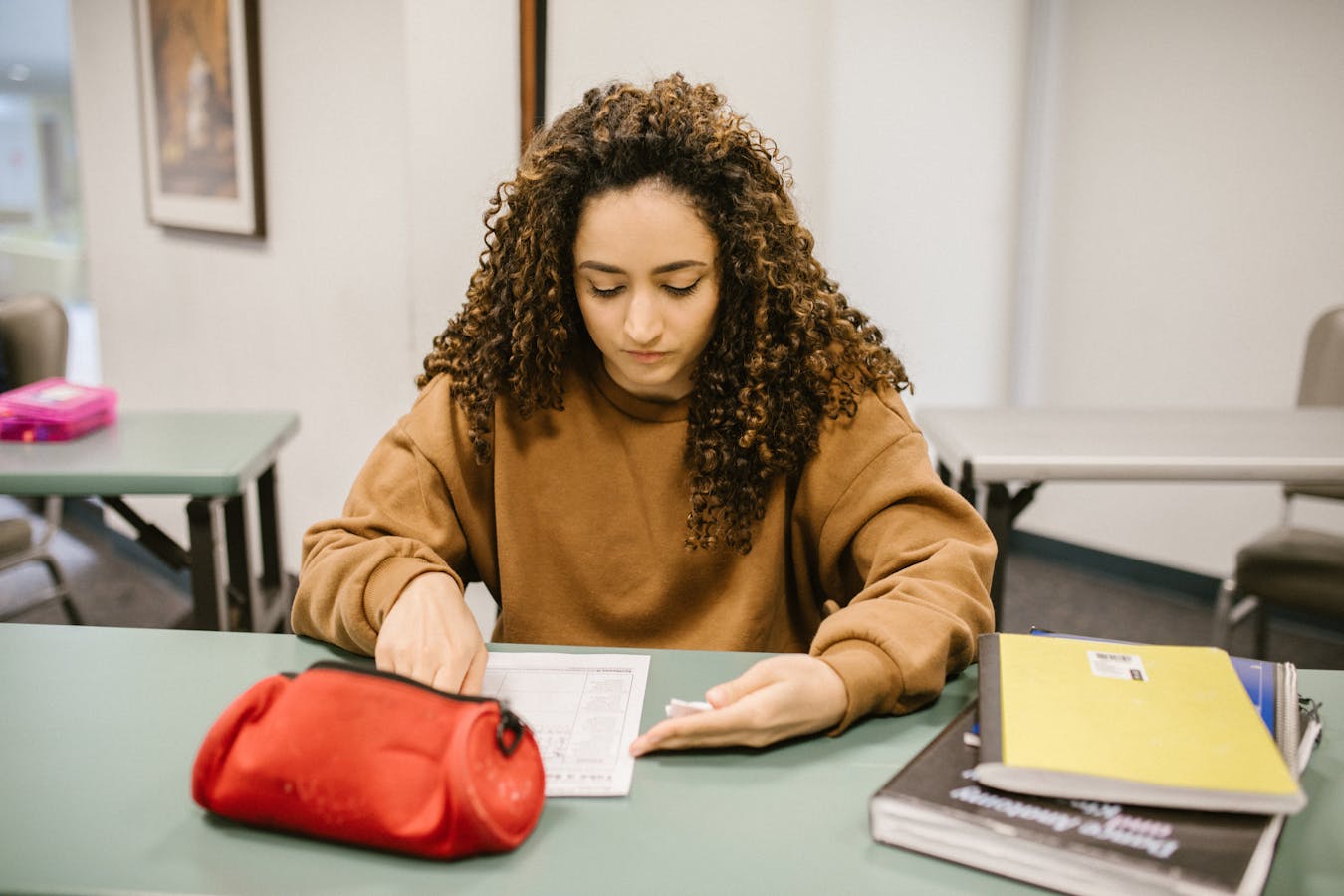
How to Manage Your Time During an Exam: A Practical Pacing System
You studied. You knew the material walking in. And yet you walked out with that sinking feeling because you spent forty minutes on question three and never even read the last page. If that sounds familiar, your problem on exam day was not knowledge. It was time.
Time management during an exam is a skill of its own, separate from how well you prepared. Two students can know the same amount and walk away with very different scores simply because one of them rationed the clock and the other did not. The good news is that pacing is learnable, and most of it comes down to a handful of decisions you make in the first five minutes and the last fifteen.
Why smart students still run out of time
Running out of time is rarely about reading slowly. It usually traces back to three habits. The first is starting at question one and grinding straight through, regardless of difficulty. The second is sinking too much time into a single hard problem out of stubbornness, what psychologists call the sunk cost trap. The third is treating every question as equally worth your minutes when the mark allocation says otherwise.
Notice that none of these are knowledge gaps. They are decisions about where your attention goes. Fix the decisions and the clock stops being your enemy.
Spend the first five minutes planning, not writing
The instinct under pressure is to start scribbling the moment you are allowed. Resist it. The few minutes you spend surveying the paper pay for themselves many times over.
Read the instructions properly. Check how many questions there are, which sections are compulsory, and whether you get a choice. Students lose easy marks every year because they answered three essay questions when they only needed two, or missed an entire section printed on the back page. Flip the paper over before you assume you have seen all of it.
As you skim, mark each question with a quick code: a tick for the ones you can answer immediately, a circle for the ones that need thought, and a star for the ones you are unsure about. Now you have a map, and you are no longer making blind decisions about what to tackle next.
Do the math on marks per minute
This is the single most useful habit, and almost nobody does it. Divide your total time by the total marks to find out what each mark is worth in minutes.
Say you have a two-hour exam worth 100 marks. That is 120 minutes for 100 marks, or roughly 1.2 minutes per mark. A question worth 5 marks deserves about six minutes. A question worth 25 marks deserves around half an hour. If you find yourself fifteen minutes into a five-mark question, that is your signal to stop, no matter how close you feel.
Build in a buffer, too. Plan to use only about 90 percent of the clock for answering so you have time left to review. For that two-hour paper, treat your working time as closer to 105 minutes and keep the final fifteen for checking.
Start with what you know
There is no rule that says you must answer in order. Begin with the questions you marked with a tick, the ones you are confident about. This does two things. It banks marks early, before fatigue or panic can set in, and it warms up your memory so that related facts start surfacing for the harder questions later.
There is a psychological payoff as well. Watching your answer sheet fill up in the first twenty minutes lowers anxiety. You walk into the difficult section already feeling like the exam is going your way, which is a far better headspace than staring at a blank page and a hard problem at the same time.
Set a personal cutoff for every question
Before you start a question, glance at the clock and decide when you will move on. When that moment arrives and you are stuck, leave it. Put a clear mark in the margin, jot down whatever partial working or key points you do have, and move to the next question.
This is hard because it feels like quitting. But the math is simple. The first half of the marks on most questions comes far faster than the last half. Three questions answered to 70 percent score more than one question polished to 100 percent while two others sit untouched. Coming back later with a fresh eye also tends to unlock the answer that would not come when you were grinding on it.
Match your effort to the marks, not your interest
It is tempting to write a beautiful, detailed answer to the question you happen to find interesting. Resist that too. A two-mark question does not want three paragraphs. Give it a crisp, direct answer and move on. Save your detail and your minutes for the questions that actually carry weight.
For essay questions, a one-minute outline before you write keeps you on track and stops you from rambling past your time budget. A short list of the points you intend to hit acts like a map of the answer, and it also means that if you do run short, the marker can still see where you were heading.
Handle multiple-choice sections with a two-pass system
Timed multiple-choice sections reward a different rhythm. On your first pass, answer every question you can do quickly and skip anything that needs real thought, flagging it as you go. This guarantees you collect all the easy marks before the clock becomes a threat.
On the second pass, return to the flagged questions with whatever time remains. Because there is usually no penalty for guessing on most modern tests, never leave a blank. Eliminate the options you know are wrong and choose from what is left. A 50 percent guess beats a guaranteed zero every time. Check the rules first, though, since a few exams still deduct for wrong answers.
Keep the clock in your peripheral vision
You cannot pace yourself against a clock you never look at. Pick two or three checkpoints in advance. In a two-hour paper you might decide that you want to be a third of the way through the marks by the forty-minute point and two-thirds through by eighty minutes.
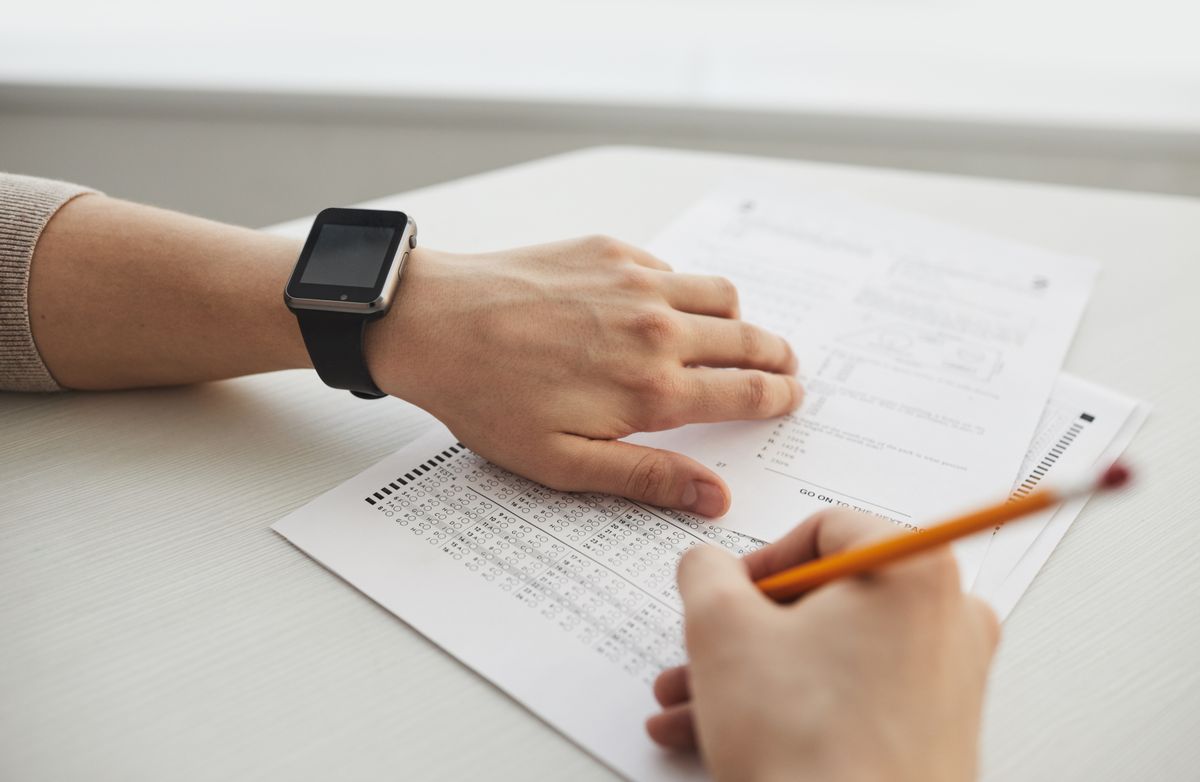
If you hit a checkpoint behind schedule, you make a calm adjustment, speeding up or cutting a planned detour, rather than discovering with ten minutes left that you are in trouble. Wear a watch or confirm there is a visible clock before the exam starts, since not every room has one you can rely on.
Protect the last fifteen minutes for review
Those final minutes are some of the most valuable on the whole paper, and rushing to fill in one more answer often wastes them. Use the time to go back to the questions you flagged, fill in anything you left blank, and read over your work.
Check that your answer numbers line up with the question numbers, that you did not skip a sub-question, and that your handwriting is legible. Fix obvious slips in spelling or arithmetic. Confirm you answered the right number of questions and did not accidentally do too many or too few. These small corrections routinely recover marks that you already earned but nearly threw away.
The work that happens before exam day
Pacing under pressure is a skill, and skills need rehearsal. The most effective preparation is the timed mock exam, done under conditions as close to the real thing as you can manage. Sit at a desk, set a timer for the real duration, and work a full past paper without pausing.
Timed practice teaches your body what the pace feels like, so that on the day you instinctively know whether you are ahead or behind. It also surfaces the questions that always eat your clock, which is exactly the information you want before the exam rather than during it. Generating practice questions from your own notes and then answering them against a timer is one of the fastest ways to build this instinct, and it doubles as active recall, which research consistently ranks among the strongest study methods.
Do not overlook the basics either. Aim for seven to eight hours of sleep the night before, since a rested brain reads faster, makes fewer careless errors, and stays calmer when a hard question appears. Arrive early so you are not starting the clock already flustered, and bring a backup pen.
A simple plan you can carry into any exam
You do not need to memorize a long list of rules. Carry these few moves in your head and the rest follows naturally. Spend the first five minutes reading and mapping the paper. Work out what each mark is worth in minutes. Start with the questions you know. Set a cutoff for each question and honor it. Match your effort to the marks on offer. Keep an eye on two or three time checkpoints. And guard the last fifteen minutes for review.
Knowledge gets you to the exam room. Pacing is what turns that knowledge into a score. Practice the clock the same way you practice the content, and exam day stops being a race you are losing and becomes one you have already rehearsed.
Ready to Create Better Exams?
Join thousands of educators using QuickExam AI to save time and create engaging assessments.