How to Study for Open-Book Exams: Strategies That Actually Work
How to Study for Open-Book Exams: Strategies That Actually Work
Most students hear "open-book exam" and breathe a sigh of relief. No memorization, no late-night cramming, just bring the textbook and look up whatever you forget. That mindset is exactly why open-book exams trip up so many otherwise prepared students.
The truth is uncomfortable. Open-book exams are often harder than closed-book ones, not easier. Professors design them assuming you have your notes available, which means the questions are written to test how well you can apply, analyze, and synthesize information rather than recall it. If you walk in unprepared, your textbook becomes a 600-page maze you cannot search fast enough.
This guide walks through how to actually prepare for an open-book exam, what to bring, how to organize it, and the mistakes that cause smart students to run out of time.

Why Open-Book Exams Are Harder Than They Look
A closed-book exam asks: do you remember the formula for compound interest? An open-book exam asks: given a loan with these terms, this credit score, and these market conditions, which financing option saves the borrower the most money over five years, and why?
The difference matters. The first question rewards memorization. The second rewards understanding. You can have every formula in front of you and still get the second question wrong if you do not understand which formula applies, when, and what the answer means.
Cornell University's Learning Strategies Center makes this point bluntly. Open-book exams "require you to really understand material and be able to apply or analyze information and content rather than just remember it." The University of Melbourne adds that these tests "tend to ask students to apply, analyze, synthesize, compare, contrast, or evaluate information."
Translation: looking up facts will not save you. You need to know the material well enough that you barely need to look anything up.
The Biggest Mistake: Treating It Like a Reference Test
Walk into an open-book exam thinking you can search your way to good answers, and you will lose. Time is the constraint, not knowledge access.
Imagine a 90-minute exam with eight questions. That is roughly 11 minutes per question. If you spend even five of those minutes flipping through your textbook trying to find the right chapter, you have less than six minutes to read the question carefully, plan an answer, write it, and review it. Repeat that across eight questions and you finish two questions short.
Students who treat open-book exams as reference tests almost always run out of time. Students who treat them as application tests, where notes are a safety net rather than a primary source, almost always finish.
The Saint Leo University study skills team puts the rule simply: "Open book does not mean that you don't need to prepare or study." Show up already knowing the material. Use your notes to verify, double-check, and clarify, not to learn anything new mid-exam.
What to Study Before the Exam
Your study plan for an open-book exam looks different from a closed-book one. Pure memorization is less important. Conceptual fluency is everything.
Focus on understanding, not recall. Instead of asking "can I list the seven stages of mitosis," ask "can I explain why a cell with damaged DNA might be stuck in the G2 checkpoint, and what proteins are involved." The first is a memory question. The second is the kind of question your professor will actually ask.
Practice applying concepts to new scenarios. Pull old problem sets, sample exams, or end-of-chapter questions you have not seen before. Work through them under time pressure. If you stumble, note where the gap is, fill it, then try a similar problem the next day. Research from Dunlosky and colleagues consistently shows that practice testing is one of the two most effective study methods, the other being spaced practice.
Make connections between topics. Open-book exams love questions that span multiple chapters. The professor knows you have your notes, so they write questions that force you to combine ideas. Map out how topics connect: which formulas relate, which historical events caused which others, which biological processes interact. A one-page concept map of the whole course is worth more than 50 pages of detailed notes during the exam.
Identify your weak spots and overstudy them. During the exam, you will not have time to read a full chapter on a topic you barely covered. Whatever you find confusing now is what will cost you points. Spend extra time there before the exam, not during.
What to Bring (And What to Leave at Home)
The instinct is to bring everything. Every textbook, every handout, every set of lecture slides, every page of notes from the entire semester. This is the second-biggest mistake students make.
The more material you bring, the more you have to search. Cornell's guide warns directly: "There is such a thing as too much when it comes to your reference materials. The more you have, the more you need to look through to find what you need."
What actually works:
A condensed summary sheet. One or two pages covering the entire course. Key formulas, definitions, frameworks, and rules. This should be the first thing you reach for during the exam. If you can fit it on one page, your understanding is already strong.
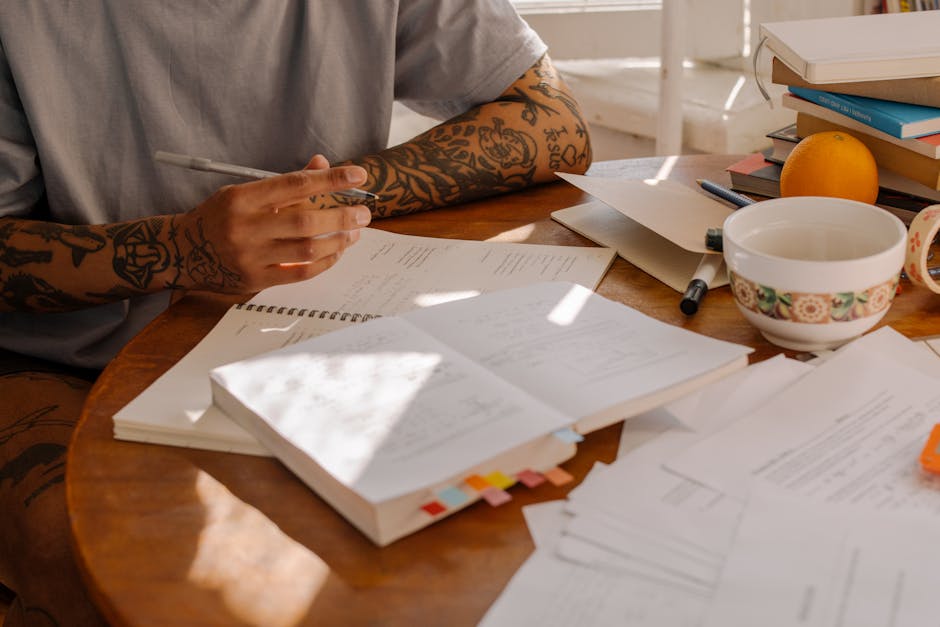
A tabbed textbook (if allowed). Use sticky tabs with chapter or topic labels so you can jump to any section in three seconds. Color-code by theme. Do not waste time during the exam flipping through hundreds of pages.
Organized lecture notes with a table of contents. Whether digital or paper, your notes need an index at the front. Topic, page number. That is it. A table of contents turns a 100-page binder into a searchable reference.
Worked examples for problem-solving courses. If your exam involves problem solving (math, physics, accounting, statistics), bring two or three fully solved examples for each problem type. When you hit a question that looks similar, glance at the worked example, see the structure, then solve the new problem. This is faster than re-deriving the method from scratch.
Skip the original full-length readings. If you needed to bring an entire research paper, you do not understand it well enough. Replace it with a one-paragraph summary of the main argument, methods, findings, and limitations. That is what you will actually use.
How to Organize Your Notes
Disorganized notes are worse than no notes. If you have to read three pages to find one fact, you have already wasted the time you would have spent thinking about the answer.
Group by concept, not by date. Students often keep notes in chronological order because that is how class was taught. For an exam, this is the wrong structure. Reorganize so all notes on, say, Keynesian economics live together, regardless of which week they were covered.
Use a consistent visual hierarchy. Big headings for major topics. Subheadings for subtopics. Bullet points for details. Bold or highlight the most important terms. Your eye should be able to scan a page and find what you need in under five seconds.
Cross-reference related topics. At the bottom of each section, write something like "see also: page 12 (related framework), page 34 (counterexample)." This turns your notes into a navigable web instead of a linear document.
Create a master index. First page of your notes binder, last page if digital. List every major topic with a page number. Update it as you study. This is the single highest-value thing you can do for an open-book exam.
Build problem-type playbooks. For math, science, or any quantitative course, make a one-page sheet for each problem type. What inputs does this type of problem give you? What is the goal? What is the standard approach? What are the common mistakes? When the exam hits, you check the playbook, follow the steps, and move on.
Practice Under Realistic Conditions
You would never run a marathon without training. Do not walk into an open-book exam without rehearsing.
Simulate the time pressure. Find or write practice questions, set a timer matching the exam length, and answer them with only the materials you plan to bring. No phone, no internet, no extra notes. This shows you exactly how prepared you are and where your materials fail.
Time yourself per question. Divide the total time by the number of questions. Set a stopwatch for each one. If you go over by more than 50%, that is a sign you are over-relying on lookup time. Either your materials need better organization or your understanding needs more depth.
Test your search speed. Pick a random topic from the course. Open your notes. How long until you find a useful summary of that topic? If it is more than 15 seconds, your notes need restructuring. Do this drill 10 to 15 times across different topics.
Review your practice answers critically. Did you waste time looking up things you actually knew? Did you miss connections between topics? Did your notes have gaps? Adjust before the real exam.
[](https://quickexamai.com)
Online and Take-Home Open-Book Exams
Online open-book exams add their own challenges. The biggest is the temptation to over-search. With the entire internet at your fingertips, students often spend 20 minutes on Google trying to verify something they already knew.
Trent University's academic skills guide is direct on this: "If permitted, search engines should be a last resort, not a starting point." Treat the internet the way you would treat the textbook in a paper exam, as a verification tool, not a learning tool.
For take-home exams that span hours or days, the failure mode is different. Students often start late, panic, and submit rushed work. Build a schedule. Day one: read all questions, plan answers. Day two: write first drafts. Day three: review and submit. Treat it like a short writing assignment, not an exam.
Watch out for one trap specific to long take-home exams: scope creep. Your professor said 500 words per question. Write 500 words. Padding answers with everything you know does not raise your grade and often lowers it because graders interpret the bloat as confusion.
Mistakes That Cost Students Points
After working through the strategy, here are the specific failures that show up over and over:
Skipping preparation. Students who think open-book means easy walk in cold and learn the hard way that they cannot understand new material in real time.
Bringing everything. A backpack of unsorted material is a backpack of distractions. You will spend more time deciding which book to open than reading the answer.
Spending too long on one question. When a question is hard, students dig in, looking through notes for 15 or 20 minutes. By the time they move on, three other questions are now too rushed to score well. Set a hard time limit per question. If you hit it, write what you have and move on. Come back at the end.
Copying directly from notes. Open-book does not mean copy-paste-book. Most professors deduct points for answers that read like transcribed textbook passages. Synthesize in your own words.
Ignoring the question structure. Open-book questions almost always ask you to apply, compare, evaluate, or analyze. If your answer is a list of facts, you have answered the wrong question. Read the verb. Match your structure to it.
Forgetting to check the syllabus rules. Some professors restrict what materials are allowed. Some prohibit AI tools. Some allow notes but not the textbook. Always reread the rules a day before the exam.
A Smarter Way to Generate Practice Questions
One of the harder parts of preparing for an open-book exam is finding good practice questions. Textbook end-of-chapter problems are usually too easy and too disconnected from the application-style questions you will actually face.
This is where AI study tools earn their keep. You can paste your lecture notes or a chapter outline into a tool that generates application-level questions across topics, scenario-based problems that combine multiple concepts, and follow-up questions that probe whether you actually understood your first answer or just got lucky.
QuickExam AI is built for exactly this. Upload your notes or paste your study material, and it generates exam-style questions matched to the difficulty level you set. You can practice under time pressure, review your answers, and identify gaps before the real exam.
The point is not to replace studying. The point is to test yourself on the kinds of questions an open-book exam will actually ask, the kind your textbook does not cover.
The Night Before and Morning Of
Two final pieces. The night before an open-book exam, do not study new material. Your brain is too tired to absorb anything useful, and last-minute cramming usually displaces what you already learned. Instead, walk through your notes' organization. Make sure tabs are in place, the index is current, summary sheets are printed, and any digital notes are downloaded for offline access (essential if the exam is online and the wifi flakes out).
The morning of, eat real food, get there early, and spend the first two minutes scanning the entire exam. Mark the questions you know cold, the ones that need lookup, and the ones that look genuinely hard. Start with the easy ones to bank time. Save the hard ones for when your warm-up answers have built confidence.
Bottom Line
Open-book exams reward two things: deep understanding of the course material, and ruthlessly organized reference materials. They punish two habits: skipping preparation, and over-relying on lookup time during the exam.
Prepare like the test is closed-book. Bring focused, organized notes that you can search in seconds. Practice under timed conditions with realistic questions. Treat your reference materials as a safety net, not a script. Do that, and you walk in calm, finish on time, and answer questions the way the professor wanted them answered, by thinking, not by copying.
The students who do best on open-book exams are the ones who needed their notes the least. Become one of them.
Ready to Create Better Exams?
Join thousands of educators using QuickExam AI to save time and create engaging assessments.