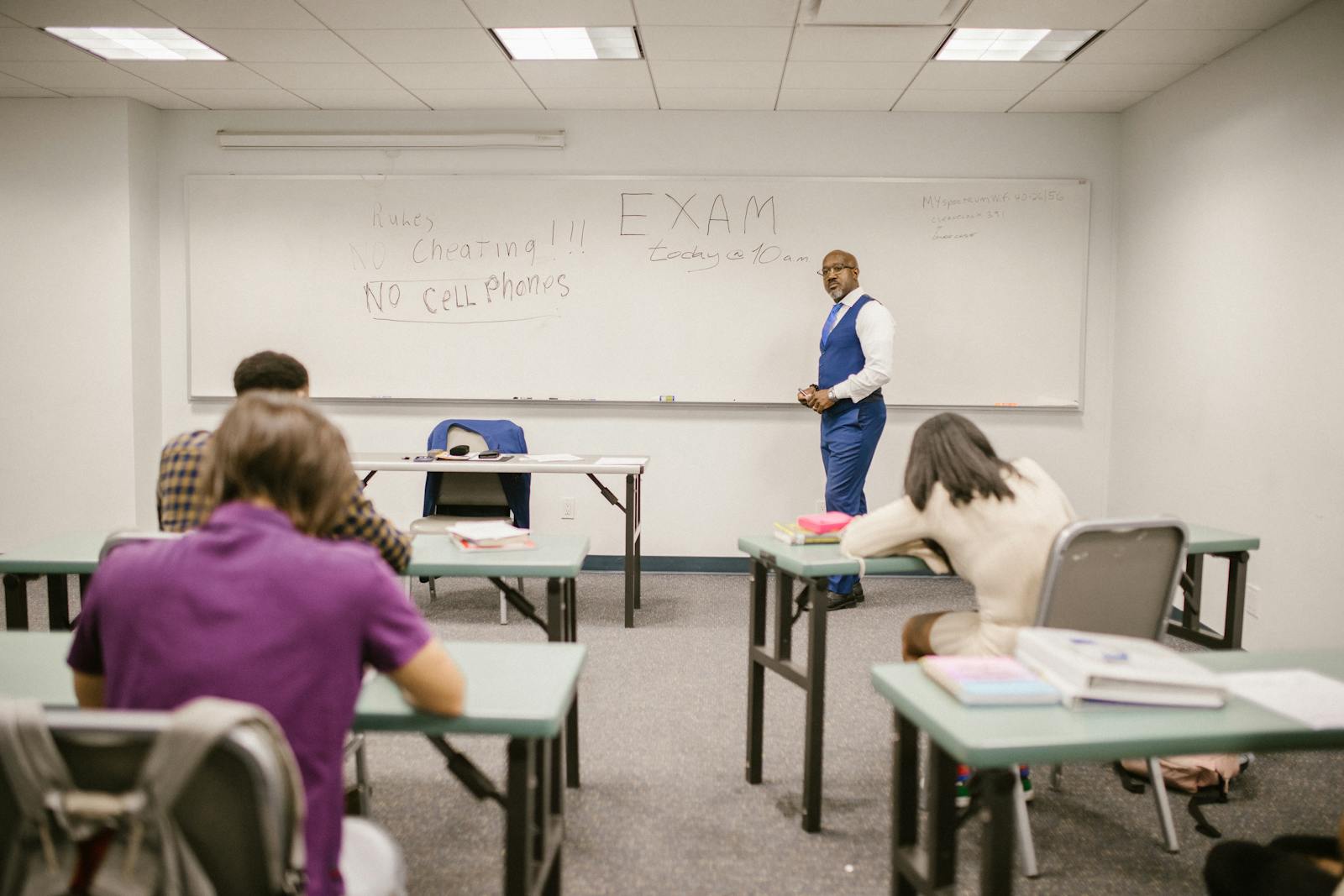
Why Cramming the Night Before Actually Sabotages Your Exam Score — And What 40 Years of Memory Research Says You Should Do Instead
My roommate in college — her name was Priya — had a ritual the night before every organic chemistry exam. She'd buy two cans of Red Bull, a family-size bag of Doritos, and barricade herself in the library's third-floor study room from 10 PM until the doors opened the next morning. She called it her "absorption mode."
Priya graduated with a 2.4 GPA.
I don't say that to be cruel. She was brilliant — genuinely, intimidatingly smart in conversation. But her study strategy was broken at a neurological level, and nobody told her. She kept doing it for four years because it felt productive. The textbook was open. The highlighters were running dry. Surely something was sticking?
Almost nothing was.
The Uncomfortable Math Behind Cramming
Here's a number that should bother you: students who cram retain roughly 10-15% of material after just one week, compared to 50-80% for students who space out the same total study time across multiple sessions. That's not a marginal difference. That's the gap between passing and failing.
Hermann Ebbinghaus mapped this out in 1885 — yes, 1885 — with his famous forgetting curve experiments in Berlin. The man sat alone memorizing nonsense syllables like "ZOL" and "DAX" and meticulously recorded how fast he forgot them. His finding was brutally simple: memory decay is exponential, and the only thing that flattens the curve is repeated exposure across time gaps.
We've known this for 141 years. And yet approximately 75% of college students still report cramming as their primary exam preparation strategy, according to a 2024 survey by the National Survey of Student Engagement conducted across 314 U.S. institutions.
Why? Because cramming works for exactly one thing: short-term recall in the next 12 hours. And that's just enough to trick you into thinking you learned something.
What Your Brain Actually Does While You Sleep After Cramming
Dr. Robert Stickgold at Harvard's sleep lab has spent decades studying how memory consolidation works during sleep. His work tells an uncomfortable story for crammers.
When you study material for the first time, your hippocampus creates what neuroscientists call a "labile" memory trace — fragile, temporary, easily overwritten. Think of it as writing in wet sand near the shoreline. The information exists, briefly, before the next wave arrives.
For that memory to become durable, it needs to be replayed during slow-wave sleep and transferred to the neocortex for long-term storage. This process — called systems consolidation — takes hours. Multiple cycles of it, actually. And here's the kicker: it works dramatically better when the memory has been reactivated multiple times before the consolidation attempt.
So when you cram from midnight to 6 AM and then walk into a 9 AM exam on two hours of sleep, you've done possibly the worst thing imaginable. You've created a mountain of labile memory traces and then denied your brain the sleep it needed to consolidate any of them. It's like cooking an enormous meal and then throwing it all in the garbage before anyone eats.
The Spacing Effect: Boring Name, Absurd Results
The antidote to cramming has an unfortunate marketing problem. It's called the "spacing effect" — sometimes "distributed practice" — and it sounds about as exciting as filing taxes. Nobody's making TikToks about it. No productivity guru is selling a course on it. It just quietly works.
The principle: instead of studying Topic X for four hours on Thursday night, study it for one hour on Monday, one hour on Wednesday, one hour on Friday, and one hour on Sunday. Same total time. Wildly different results.
A meta-analysis published by Cepeda et al. in Psychological Bulletin in 2006 — covering 317 experiments with over 14,000 participants — found that spaced practice produced a median improvement of 49% in long-term retention compared to massed practice (cramming). Forty-nine percent. From the same amount of study time, just rearranged.
And the benefits compound. Dr. Sean Kang at the University of Melbourne ran a study in 2016 showing that spacing combined with retrieval practice (testing yourself rather than re-reading) boosted retention to nearly triple what cramming achieved on assessments given 30 days later. Not 30 hours. Thirty days.
If you're studying for a certification exam that you need to pass on your first attempt, this isn't academic trivia. It's the difference between $400 wasted on a retake fee and moving on with your career.
Why Cramming Feels So Good (and That's the Problem)
There's a psychological trap here that's worth naming. Psychologists call it the "fluency illusion" — when information feels familiar during a study session, your brain interprets that familiarity as learning.
You've been staring at the same page for 45 minutes. You can practically recite it. You close the book and think, "Got it." But what you actually have is recognition memory — the ability to say "yes, I've seen this before" — not recall memory, which is what exams test. Recognition and recall are neurologically distinct processes, handled by different brain circuits. One does not guarantee the other.
Cramming maximizes recognition while doing almost nothing for recall. It's the study equivalent of watching someone cook on YouTube and assuming you can now make beef Wellington. Technically, you've been exposed to all the information. Practically? You'll burn the pastry.
How to Actually Do This (Without Being Insufferably Organized)
I know what you're thinking. "Great, I need to plan my studying weeks in advance. That's never going to happen." Fair. Most spacing effect advice assumes you're the kind of person who color-codes their calendar and meal-preps on Sundays. Most students aren't.
Here's a more honest approach:
Rule of Two Touches Minimum. Whatever you're studying, touch it at least twice before the exam with a gap of at least 24 hours between touches. Even this basic version significantly outperforms cramming. Two touches with a gap beats five hours straight. Every time.
Make the second touch retrieval, not review. The first time, read and take notes. The second time, close everything and turn your notes into practice questions. Quiz yourself. Get things wrong. The struggle of trying to recall is literally what builds the neural pathways. Re-reading is the junk food of studying — satisfying in the moment, nutritionally empty.
Use dead time. You don't need marathon sessions. Twenty minutes on the bus reviewing flashcards. Fifteen minutes before bed doing a practice quiz. These micro-sessions, scattered across days, are neurologically superior to a four-hour library prison sentence.
Front-load hard material. Start with whatever confuses you most. Your brain needs maximum spacing for the hardest concepts — and spacing means starting early. The stuff that already makes intuitive sense? That can wait.
Interleave topics. Don't study Chapter 3 for an hour, then Chapter 4 for an hour. Mix them. Do 20 minutes of Chapter 3, switch to Chapter 7, come back to Chapter 3. This feels terrible — slower, more confusing — but a 2014 study by Rohrer and Taylor at the University of South Florida found interleaved practice improved test performance by 43% compared to blocked practice. The discomfort is the point. Your brain is working harder, which means it's learning more.
The Emergency Spacing Protocol (For When You Procrastinated Anyway)
Look, I'm a realist. Sometimes you have 48 hours before an exam and you haven't started. It happens. Here's how to apply spacing principles even in a compressed timeline:
Day 1 evening (let's say Tuesday): Two hours of initial study. Focus on understanding the big picture. Don't try to memorize details — just build a mental scaffold. Go to sleep.
Day 2 morning (Wednesday): 45 minutes of retrieval practice. No books open. Write down everything you can remember from last night. The gaps you notice? Those are your priority targets.
Day 2 afternoon: One hour filling in the gaps you identified. Then stop. Do something else. Walk, eat, stare at a wall — whatever. Your brain needs the downtime. Research from Dr. Lila Davachi's lab at Columbia showed that wakeful rest after learning improved memory consolidation by up to 20%, even without sleep.
Day 2 evening: Final 45-minute session. Pure practice problems or self-testing. Then sleep. A real night's sleep — seven hours minimum.
Is this as good as studying over two weeks? Absolutely not. But it's meaningfully better than a single all-night cram session. You've created three separate memory encoding events with gaps between them. That's three chances for consolidation instead of one.
The Tools That Make Spacing Stupid-Easy
Anki has been the gold standard for spaced repetition flashcards since 2006, and it's still free, still ugly, still incredibly effective. The algorithm automatically schedules your reviews based on how well you know each card. If you get it right, it spaces the next review further out. Wrong? It brings it back sooner.
But Anki requires you to create the cards yourself, and that's where most people give up. AI-powered tools like AI quiz generators can take your notes, lecture slides, or textbook chapters and produce practice questions automatically — which you can then review on a spaced schedule. The card creation bottleneck used to be the biggest obstacle to spaced repetition adoption. That bottleneck is essentially gone now.
The specific tool matters less than the principle. Whether it's Anki, Quizlet, or pen and paper — the spacing is what works. Not the technology.
One Last Thing About Priya
I ran into her at a conference in Portland three years after we graduated. She'd gone into UX research, was doing well at a mid-size tech company. We grabbed coffee and somehow the topic of study habits came up.
"I figured out the spacing thing in grad school," she said. "My advisor literally banned me from studying more than 90 minutes at a time. I thought she was crazy. Then I aced comps on my first try for the first time in my life."
She paused and stirred her latte.
"I wasted so much time in undergrad thinking effort was the same thing as effectiveness. They're not even close."
No. They're not.
If you want to stop wasting your study time and start actually retaining what you learn, the fix isn't working harder. It's working across time. Space it out. Test yourself. Sleep on it. Do it again. It's not sexy. It just works.
Ready to Create Better Exams?
Join thousands of educators using QuickExam AI to save time and create engaging assessments.