How to Study with ADHD: The Exam Prep System That Actually Works With Your Brain

Most study guides tell you to find a quiet room, sit down for two hours, and read your textbook carefully. For students with ADHD, following that advice often ends in 90 minutes of staring at the wall, a reorganized pencil case, and absolutely no information retained.
The issue isn't willpower or intelligence. ADHD affects working memory, attention regulation, and impulse control — not how smart you are. When you try to study the same way as everyone else, you're asking your brain to run software it wasn't designed for.
This isn't about excuses. It's about finding the system that actually works for your brain, so you walk into your exam knowing the material instead of knowing you spent four hours pretending to study.
What ADHD Actually Does to Studying
Understanding what's happening in your brain makes the strategies make more sense.
ADHD is primarily a disorder of executive function. That means your brain has trouble with task initiation (starting to study), sustained attention (staying focused), working memory (holding information while you use it), and emotional regulation (not spiraling when studying feels impossible).
Here's what that looks like in practice: You sit down to study chemistry. You open your notes. You notice a typo on page three and spend twenty minutes fixing all the typos. You realize you're hungry. You get a snack. By the time you get back, you've forgotten what chapter you were on. The timer says it's been an hour and you've covered two paragraphs.
None of this is laziness. Your brain's dopamine system works differently — it gets bored faster, seeks novelty more aggressively, and struggles to sustain effort on things that don't produce immediate feedback. Once you understand that, you can build a study system around it instead of fighting it.
Strategy 1: Break Time Differently Than Everyone Else
The Pomodoro Technique — 25 minutes on, 5 minutes off — is often recommended for ADHD students, and it's a reasonable starting point. But many ADHD students do better with even shorter intervals: 15 minutes of focused work, then a real break.
What matters more than the exact timing is that the break is actually a break. Walk around. Get water. Do five jumping jacks. Don't scroll through your phone. Phone scrolling doesn't rest your brain — it consumes a different type of attention, and you'll come back to studying feeling more scattered than when you left.
Try this instead: Set a visible timer (not your phone — a physical cube timer or a browser extension). Work until it goes off. Then physically stand up and move for three to five minutes. The physical movement isn't optional — it raises dopamine levels and genuinely helps ADHD brains reset.
If you find yourself in a flow state when the timer goes off, keep going. ADHD brains can hyperfocus, and you don't want to break that. The timer is a floor, not a ceiling.
Strategy 2: Your Environment Probably Needs to Be Louder, Not Quieter
Standard study advice: go somewhere quiet and distraction-free.
ADHD reality: complete silence is sometimes the worst environment for focus.
Many people with ADHD study better with background noise — a coffee shop, lo-fi music, brown noise, or ambient sound. The reason is counterintuitive: a completely quiet environment gives your restless brain nothing to process in the background, so it starts generating its own distractions. A moderate level of ambient noise keeps that background processing occupied, freeing your foreground attention for actual work.
Brown noise and white noise are often better than music with lyrics, since lyrics compete with the verbal parts of studying. YouTube has hours-long brown noise videos. Apps like Brain.fm are designed specifically for ADHD focus.
Find what works for you by experimenting, not by trying to force the library setup everyone else uses. If you retain more studying in a coffee shop, study in a coffee shop.
Strategy 3: Body Doubling Actually Works
Body doubling is having another person present while you work — not helping you, just there. It could be a friend studying their own material, a parent reading in the same room, or even a virtual study session on video call.
Research and widespread ADHD community experience both support this. The presence of another person seems to activate a different kind of attention regulation, making it easier to stay on task. Nobody fully understands why it works, but it does work consistently enough that it's worth building into your routine.
Apps like Focusmate match you with strangers for 50-minute virtual work sessions. You turn your camera on, say what you're working on, work, and check in at the end. Thousands of ADHD students swear by it for exactly this reason.
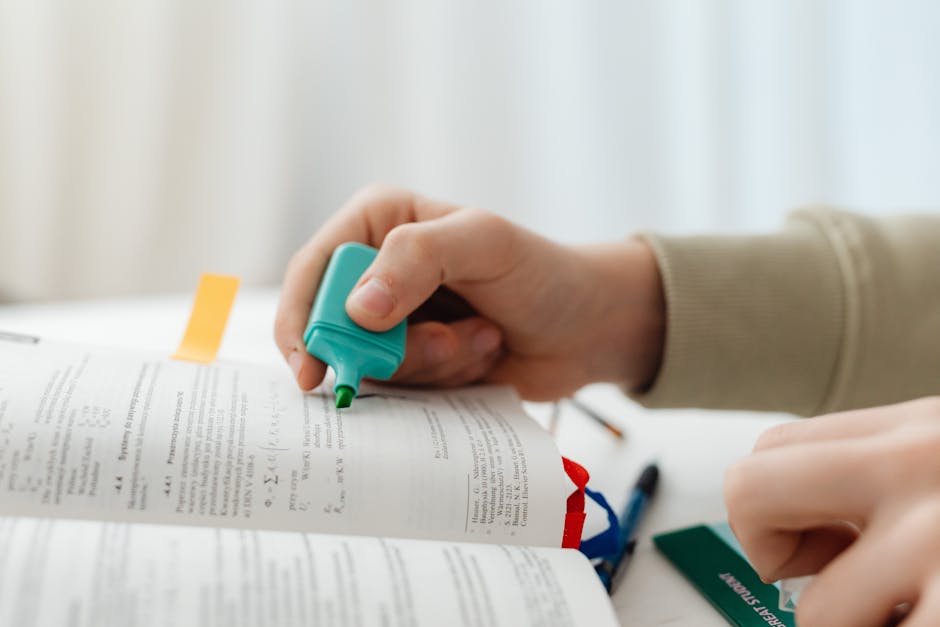
Strategy 4: Stop Highlighting and Start Retrieving
Passive review — re-reading notes, highlighting textbooks, watching lecture recordings — feels productive because you're looking at information. But for ADHD brains, passive review is especially ineffective. Your eyes move across the words while your brain is somewhere else entirely.
Active recall forces your brain to actually generate information, which creates stronger memories. The process works like this: read a section of your notes, then close them and write down everything you remember. Check what you missed. Do it again. Each time you struggle to retrieve something, you're strengthening that memory more than any amount of re-reading would.
Practice tests are one of the best tools for active recall, and they work particularly well for ADHD students because they create a clear goal, immediate feedback, and a structured challenge that holds attention better than passive review. Instead of asking yourself "do I understand this chapter?" — which is hard to answer — you take a practice test and immediately see what you know and what you don't.
QuickExam AI generates practice tests directly from your notes or any study material you upload. For ADHD students, this turns a passive pile of notes into an active testing session in minutes, changing studying from an open-ended slog into a structured challenge with clear progress markers.

Strategy 5: Gamify the Session
ADHD brains respond strongly to reward and novelty. You can use this deliberately.
Point systems: Give yourself one point per flashcard reviewed, two points per practice question answered correctly. Set a target — "I need 50 points before I stop this session." Track points visibly on paper or a whiteboard next to your desk.
Apps like Habitica turn your study tasks into a role-playing game where you earn experience points and level up a character. Forest lets you grow a virtual tree that dies if you leave the app. These feel silly until you realize they actually work.
The mechanism is straightforward: ADHD brains struggle to generate internal motivation for tasks with delayed rewards. An exam in three weeks isn't motivating right now. A growing tree or accumulating points provide the immediate feedback loop your brain needs to keep going.
Strategy 6: Use Color and Spatial Organization
ADHD and visual processing often go together. Notes that are a wall of black text are harder to engage with than notes that use color, diagrams, and spatial arrangement.
Try color-coding by topic: all definitions in blue, all formulas in green, all examples in orange. When you review, your brain has a visual hook to hang information on. During an exam, you can sometimes literally picture where on the page something was and what color it was.
Dual coding — combining verbal and visual information — works particularly well for ADHD students. Instead of just writing "the mitochondria produces ATP through oxidative phosphorylation," draw a quick diagram showing energy in and ATP out. The visual version and the verbal version reinforce each other and give your brain two paths to retrieve the information during recall.
You don't need to be artistic. Stick figures, arrows, and boxes are enough. The act of deciding how to represent information visually is itself a form of active processing that helps memory stick.
Strategy 7: Exam Day Protocols
How you prepare the day of the exam matters as much as how you studied in the weeks before.
Exercise before the exam if you can. Even 20 minutes of walking raises dopamine and norepinephrine — the exact neurotransmitters that ADHD medications target. Aerobic exercise has been shown in multiple studies to improve focus and working memory in ADHD populations for several hours afterward. If you can go for a run before a morning exam, do it.
Eat something real. Low blood sugar crashes ADHD brains fast. Protein and slow carbs before an exam are better than caffeine on an empty stomach — coffee without food often makes ADHD symptoms worse, not better.
Get there early. ADHD brains handle transitions poorly, and the stress of running late before an exam can spike anxiety in ways that hurt performance for the first twenty minutes of the test. Being settled and calm before you start is worth the time.
During the exam: if time allows, skim all the questions first. Your brain will start processing answers in the background while you work through the exam in order. Skip questions that stump you immediately — mark them and come back. Spending too long stuck on one question is a common ADHD exam trap that costs more points than the stuck question is worth.
A Note on Medication
If you're prescribed ADHD medication, take it consistently during study periods — not just during exams. Studying while medicated and taking exams while medicated produces better encoding and more reliable recall than studying without and testing with. The point isn't to get a boost on exam day. It's to have your brain in a consistent state during both learning and retrieval, so the two experiences match.
If you're not on medication or considering it, talk to a doctor rather than making decisions based on other people's experiences. What works for someone else's brain chemistry may not be right for yours.
Building a System You'll Actually Use
The worst study system is the one you abandon after two days. Before finals season hits, build a system you can realistically execute:
- Pick a consistent start time — initiation is hardest, so eliminate the decision by making it automatic
- Set up your environment before you sit down — no searching for your charger after you've started
- Choose a body-doubling option for at least some sessions
- Default to active recall over passive review — close your notes and test yourself
- Use a visible timer with short intervals, not your phone
- Know your noise preference and set it up before you start
None of these are complicated. What makes them work is consistency. An ADHD brain benefits enormously from predictable structures — not because it likes routine, but because reducing the number of decisions at session-start reduces the chance that task initiation fails entirely. Every choice you have to make before studying begins is a chance for your brain to find something more interesting to do instead.
The Bottom Line
Studying with ADHD isn't about trying harder to be neurotypical. It's about understanding how your brain processes information — short intervals, external accountability, active retrieval, immediate feedback, movement — and building a study system that uses those features instead of fighting them.
You don't need four unbroken hours of quiet focus. You need a series of 15-minute active recall sessions, a bit of background noise, a friend on a video call, and practice tests that tell you exactly what you know and what you don't. That's a system most ADHD students can actually build and keep building on, even the week before finals.
Ready to Create Better Exams?
Join thousands of educators using QuickExam AI to save time and create engaging assessments.