How to Memorize Formulas for Math and Science Exams: 9 Methods That Actually Stick
How to Memorize Formulas for Math and Science Exams: 9 Methods That Actually Stick
The night before a physics final, students stare at a sheet with sixty equations on it and try to memorize all of them. By morning, half are gone. By the time the exam starts, only the ones used in the last practice problem are still clear. Then a question hits that needs the angular momentum formula, and there is nothing there.
This pattern is not a memory problem. It is a method problem. Formulas are stored in the brain very differently from facts like dates or vocabulary, and the standard advice — rewrite them, recite them, tape them to the bathroom mirror — works against how that storage actually happens.
Here is what the research on long-term retention says about formulas specifically, and nine methods that hold up when the exam clock starts.
Why Memorizing Formulas Feels Harder Than Other Material
Formulas are not arbitrary strings. They are compressed relationships between physical or mathematical quantities. When a student tries to memorize F = ma as three letters and an equals sign, the brain treats it the same way it treats a random license plate. Random material decays fast — typically more than 70 percent within 24 hours according to classic forgetting-curve research.
But when a student understands that force is what changes motion, and that more mass needs more force to produce the same change in velocity, F = ma stops being a string. It becomes a sentence. Sentences with meaning persist roughly an order of magnitude longer than meaningless ones.
So the first principle: any method that treats formulas as symbols to memorize will lose to any method that treats them as compressed ideas.
Method 1: Derive Before You Memorize
For every formula on the exam, find one derivation or one physical reason it has the shape it does. The kinetic energy formula KE = (1/2)mv² is not random — the half comes from integrating velocity, and the v² is what makes a car going 60 mph hit four times as hard as one going 30. Once a student can sketch where the formula comes from in two lines, the formula itself becomes hard to forget.
This costs about ten minutes per formula the first time. After that, the formula is retrievable from the reasoning if it ever slips. Trying to remember sixty isolated equations costs ten hours of cramming and still loses half by morning. The math is brutal: derive first.
Method 2: Build a Formula Sheet by Hand
The act of writing formulas out by hand — not typing them — pulls in motor memory, which is encoded in different brain regions than verbal memory. Research on note-taking shows handwritten formulas are recalled significantly better than typed ones, even when students do not look at the sheet again.
Use one page per topic. Group related formulas together: all the kinematics equations on one page, all the trigonometric identities on another. The grouping itself becomes a retrieval cue during the exam — students remember not just the formula but where on the page it sat.
Method 3: Color-Code by Function
Give every variable type a color. Velocities in blue, masses in red, time in green, accelerations in orange. The first few times this feels childish. By the third week, the colors do the work — a student looks at a problem, sees it is asking about velocity, and the blue-variable formulas surface first.
Dual coding theory, which has held up across forty years of replication, says information stored in two formats (verbal plus visual) is retrieved faster than information stored in only one. Color-coding is the cheapest possible application of this. It takes one extra minute per page of notes and pays back every time a formula needs to come back during a timed exam.
Method 4: Use Targeted Mnemonics, Not Generic Ones
Mnemonics work, but only when they are short and specific. SOH-CAH-TOA for sine, cosine, and tangent ratios is a famous example because it is exactly three syllables long and maps cleanly to nine things at once.
The trap is over-mnemonic-ing. A student who builds an acronym for every formula ends up with two memory burdens instead of one: the formula and the acronym. Reserve mnemonics for the cases where the formula is genuinely arbitrary — like the order of operations (PEMDAS) or the colors of the visible spectrum (ROY G BIV). For formulas that have physical meaning, the meaning is the mnemonic.
Method 5: Practice Retrieval, Not Recognition
This is the biggest one, and the one most students get wrong. Reading a formula and thinking "yes, I know that one" is recognition. It feels like learning but produces almost none. What produces durable memory is retrieval — closing the book, writing the formula from memory on a blank page, then checking.
A 2008 study by Karpicke and Roediger found that students who tested themselves on material remembered 80 percent of it a week later. Students who reread the same material for the same amount of time remembered 36 percent. More than double the retention, for the same time investment.
For formulas, retrieval practice looks like this: every morning, take a blank sheet, write down all the formulas from one topic without looking, then compare against the textbook. The gaps are exactly what needs work. The ones written correctly need one quick review and can mostly be ignored for a few days.
Method 6: Space the Practice Out
Cramming sixty formulas into one evening is the single least efficient way to remember them. Spreading the same total time across five sessions — say twenty minutes a night for five nights — produces dramatically better retention.
The mechanism is well understood. Each retrieval attempt that succeeds after a delay strengthens the memory more than an immediate retrieval. The harder the recall, the bigger the gain, up to the point where it actually fails. So the schedule should stretch over time: review today, again in two days, again in five days, again in two weeks.
Apps like Anki automate this with a spaced repetition algorithm, but a paper schedule works just as well. The key is that no formula should be reviewed too soon after the last successful recall — that just feels productive without doing much work.
Method 7: Apply Each Formula to At Least Three Problems
Knowing a formula in isolation is not the same as recognizing when to use it on a test. The bridge between the two is application. Take each formula from the formula sheet and find three different problems that need it, ideally with different surface features so the brain learns the formula is not glued to one problem type.
For the ideal gas law PV = nRT, that might mean a problem about a balloon expanding, a problem about gas in a sealed container heated, and a problem about partial pressure in a mixture. Same formula, three different contexts. After this, the student no longer has to remember the formula — they remember a class of situations that need it.
This is what cognitive scientists call interleaved practice, and it is one of the most replicated findings in learning research. Students who interleave formula application across topics outperform students who block-practice the same formula many times in a row, often by 40 percent on delayed tests.
Method 8: Explain the Formula Out Loud
The Feynman technique applies to formulas almost perfectly. Take any formula and explain it, out loud, in plain language, as if to a friend who has never taken the class. "This one says that the force on a charged particle in a magnetic field is the charge times the velocity crossed with the field, and the cross product means it only matters when the particle is moving across the field lines, not along them."
Where the explanation stalls is exactly where the understanding has a hole. The student can then go back and patch it, then try again. After two or three rounds, the formula is no longer something to memorize — it is something the student understands well enough to teach.
This is harder than rereading, which is why it works. Anything that feels effortful during study tends to produce more durable memory than anything that feels easy.
Method 9: Sleep Between Long Study Sessions
Memory consolidation happens during sleep — specifically during the slow-wave phase early in the night. Material studied during the day gets replayed and stabilized in long-term storage during this phase. Students who pull all-nighters skip this entirely, which is why a 12-hour cram session followed by no sleep produces worse exam performance than a 6-hour session followed by 8 hours of sleep.
The practical version: stop studying formulas at least 90 minutes before bed. Use that buffer to do something low-cognitive, then sleep. The brain finishes the job overnight.
Putting It Together: A Two-Week Formula Plan
For an exam two weeks out with around forty formulas to know:
- Days 1–3: Group formulas by topic. For each formula, write one line of derivation or physical meaning next to it. Build the handwritten formula sheet, color-coded.
- Days 4–7: Daily retrieval practice — blank sheet, write everything from one topic, check, mark gaps. Spend twice as much time on the gaps as on the formulas already known. Apply each formula to one problem.
- Days 8–11: Mixed retrieval across topics. Each formula should now be applied to at least three different problems. Explain three formulas a day out loud.
- Days 12–13: Light review only. Quick blank-sheet recall, no new material. Two short sessions per day, with sleep between them.
- Day 14: Skim the formula sheet once in the morning. Trust the work.
This is roughly 8 hours of total study spread out, versus the 12+ hours typical of cramming, and it produces measurably better outcomes on every cognitive science replication.
What Not to Do
A few methods that look productive but mostly waste time:
- Rereading the formula sheet repeatedly. Feels like learning, produces almost no transfer to recall.
- Watching videos of someone else doing the problems. Passive observation, no retrieval, low retention.
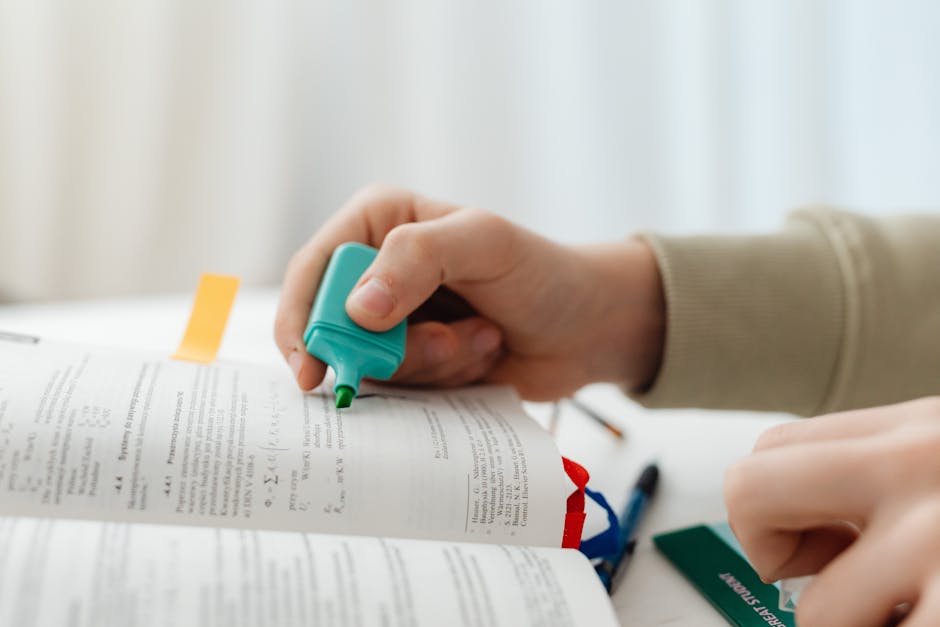
- Color-highlighting the textbook. Visual but not generative — the highlighter does the work the brain should be doing.
- Group cramming the night before. Social pressure, mostly recognition, almost no retrieval, and skips sleep consolidation.
The pattern: anything that feels easy during study is suspect. The methods that produce real retention all have one thing in common — they make the student actively generate the formula from scratch, not just see it again.
The Real Goal
For most exams, the goal is not to memorize the maximum number of formulas. It is to have the right ones come back fast enough, with enough confidence, that the student spends exam time on the actual problem rather than on retrieving the equation. Every method above is in service of that.
A student who can derive a formula in 30 seconds will beat a student who memorized it but is not sure they remember it correctly. Understanding plus a few rounds of retrieval practice is, almost every time, the shortest path to that outcome.
Ready to Create Better Exams?
Join thousands of educators using QuickExam AI to save time and create engaging assessments.